


IMAGINARY FRIENDS ARE COOL! (Sometimes)

Updated: Feb 21

Imaginary friends... everybody knows them. Everybody’s heard of them. Everybody knows somebody who had them. And honestly, imaginary friends go back way further than people think.
Psychologists were studying imaginary companions back in the 1890s, and even before that, adults throughout history had their own versions: guardian angels, household gods, muses whispering in their ears.
These weren’t “imaginary friends” in the modern sense, but they filled the same role, to provide comfort, guidance, creative inspiration, and sometimes just that sense that someone else is in the room with you, even when there isn’t.
Kids, of course, made the whole concept famous. Invisible friends, pretend friends, made-up buddies... whatever you call them, they’ve been a basic part of childhood for over a century. And kids usually know they’re not real, which is kind of incredible. They’re not delusional, they’re creative.
These imaginary companions serve purposes: helping kids talk through emotions, practice social skills, rehearse life, build empathy, explore new worlds, or sometimes just have someone to blame when the lamp breaks. (That’s a classic.)
And the research is actually fascinating. Kids with imaginary friends sometimes show stronger language skills. They sometimes show better coping strategies. Sometimes they’re more empathetic, more emotionally aware, more creative.
And despite what people used to think, having an imaginary friend isn’t a sign of trouble at all, it’s actually normal. It’s healthy. It’s common. It’s play. Childhood imagination at full blast.
There’s a whole distinction between imaginary companions and personified objects, between fantasy play and actual voices, between imagination and pathology... but when it comes to the fun, harmless, imaginative kind? They’ve been around forever, and they’ve shaped storytelling more than most people realize.
And I have to say, I never had one. Not really. And that’s weird, because I’m an only child, and only children usually do have imaginary friends. Now, I definitely pretended a lot.
I acted out scenes from movies, did voices, replayed Hammer horror movies in my bedroom, pretended to be Peter Cushing fighting off Christopher Lee for the 900th time. I made up worlds, I made up stories, but not that one specific friend that you talk to every day, the way many kids do.
No direct voice in my head, no invisible buddy hanging out in the corner. Just me, my toys, and a whole lot of movie reenactments.
But imaginary friends have dominated entertainment for decades. They’re everywhere in culture: in books, in comics, on stage, in animation, in fantasy, in horror, in kids’ shows, in Oscar-winning dramas.
They show up as comforting companions, terrifying hallucinations, comic relief, metaphors, ghosts, genies, creatures, monsters, projections, and sometimes full-blown plot twists.
Calvin and Hobbes (one of the greatest comic strips of all time) is built entirely around an imaginary friend. Foster’s Home for Imaginary Friends celebrated the idea in cartoon form for years. Where the Wild Things Are? Imaginary. Bridge to Terabithia? Same.
Pete’s Dragon? ET — yes, ET can absolutely be interpreted as an imaginary friend. The Water Horse. Labyrinth. A Monster Calls. Jojo Rabbit. All imaginary friends in one form or another.
And then there’s the dark side: the horror movie imaginary friend, which is its own glorious subgenre. The Orphanage uses them brilliantly. Mr. Punch from Stuart Gordon’s Dolls is nightmare fuel. The Machinist gives us Ivan, who is a fantastic imaginary friend who’s basically guilt made flesh.
Session 9 has some wild hallucinatory stuff going on. Poltergeist starts with Carol Anne chatting with “friends” through the TV… before things get ghostly and very real.
Hide and Seek (a terrible movie, by the way) tries the “imaginary friend who might actually be something else” twist. And there’s that recent 2024 mess Imaginary, where a grown woman goes back to confront her childhood imaginary friend Chauncey, who is now a murderous teddy bear. (Terrible movie. Absolutely terrible.)
Plus, of course, Fight Club. Tyler Durden is an imaginary friend. A very violent, charismatic, shirtless imaginary friend. A Beautiful Mind tries the imaginary friend twist... badly. In typical Ron Howard fashion, everything that should be subtle is hammered into the ground with the force of a Buick.
But imaginary friends show up everywhere, in so many different shapes, because the idea is universal. One friend, made up entirely by you, who helps you cope, escape, create, process, or survive.
And the reason storytellers love imaginary friends is simple: you can do ANYTHING with them. Because they’re imaginary. They can break physics, logic, narrative rules, emotional boundaries.
They can be funny, sweet, horrifying, innocent, sinister, magical, or all of the above. They can turn out to be real, or turn out to never have existed. They can be the twist or the emotional anchor. They can be childhood fantasy or adult psychosis or something in-between. It’s an incredibly flexible storytelling tool.
And with the upcoming fantasy movie Dust Bunny (about a girl confronting the imaginary friend who lives under her bed...but is NOT imaginary at all) I figured this was the perfect time to celebrate the great imaginary friends of cinema.
There are tons of them. Some friendly. Some monstrous. Some helpful. Some dangerous. Some heartbreaking. Some iconic. Some forgotten.
Narrowing it down wasn’t easy. But I’ve put together a list of my 10 favorite imaginary friends in movie history. They’re in random order, with no ranking, just my favorites across all genres.
Some are from good movies. Some are from bad movies. Some are from horror, fantasy, comedy, drama. Some are sweet. Some are terrifying. All of them stuck with me.
MY 10 FAVORITE IMAGINARY FRIENDS IN MOVIES (in random order):
1) “Captain Howdy” from THE EXORCIST (1973)
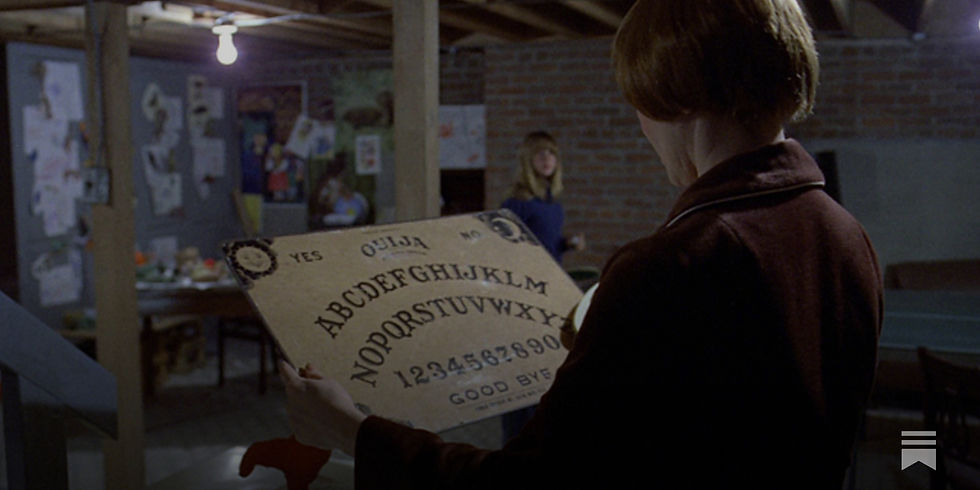
Let’s kick this thing off with one of the creepiest “imaginary friends” ever put on film: Captain Howdy. Before the pea soup and the head spinning and all the demonic mayhem, The Exorcist actually starts as a quiet story about a lonely little girl and the weird “friend” she talks to through a Ouija board.
It’s innocent at first… until it VERY MUCH isn’t. Captain Howdy is the perfect example of how kids will create a character to fill a void, and how that character can become something dangerous and sinister if you’re in a horror movie.
He’s funny, he’s playful, he’s manipulative, and of course he turns out to be Pazuzu, one of the greatest evil forces in horror history. When your imaginary friend can rearrange furniture and curse at priests? Yeah. Something’s gone wrong.
2) “The Babadook” from THE BABADOOK (2014)

This one is brilliant because the imaginary friend is also a manifestation of grief, trauma, depression, parenting exhaustion, you know, all the stuff bubbling under the surface that the main character refuses to deal with.
The Babadook is a storybook monster that may or may not be real, but that haunting top-hatted silhouette basically crawls off the page and into your psyche. He’s terrifying, yes, but also deeply symbolic.
Is he imaginary? Is he supernatural? Is he psychological? Doesn’t matter, because he crawls into the mind of a child and the unraveling insanity of a parent. He’s an imaginary friend who becomes an imaginary enemy, which is honestly even more interesting.
3) “Jodie the Pig” from THE AMITYVILLE HORROR (1979)

Ah yes, the demonic pig-creature that befriends a little girl in the world’s most cursed Dutch Colonial house. Jodie is weird, ridiculous, and creepy all at the same time. She’s supposedly a giant invisible pig with glowing red eyes who sits in rocking chairs and stares at you through windows.
Perfect imaginary friend material if you’re trying to traumatize an entire generation of kids. What I love is how Jodie starts out as “Oh, isn’t that cute, the little girl has a friend,” and becomes “THAT IS NOT CUTE ANYMORE GET OUT OF THE HOUSE.” A classic horror-movie invisible friend.
4) “Tony” and “Lloyd the Bartender” from THE SHINING (1980)

The Shining is loaded with imaginary companions... none of whom you want anywhere near you. Tony, Danny Torrance’s little voice that “lives in his mouth” (still one of the freakiest descriptions ever given), is the ultimate imaginary friend/psychic warning system. He’s like a paranormal Jiminy Cricket.
And Lloyd the Bartender? Oh, he’s fantastic. The smooth-talking, ghostly enabler of Jack Torrance’s breakdown. Both Tony and Lloyd are imaginary friends with jobs: Tony tries to protect Danny, Lloyd tries to destroy Jack. And they’re both unforgettable. Imaginary friends like this don’t help you cope, they help you descend into madness. And they’re excellent at it.
5) “Drop Dead Fred” from DROP DEAD FRED (1991)

Now we go from terrifying horror hallucinations to one of the most chaotic, obnoxious, juvenile imaginary friends ever created. Drop Dead Fred is basically a Tasmanian Devil with British sarcasm and zero impulse control.
He’s the childhood friend who comes roaring back into a woman’s life just when everything’s falling apart, and he “helps” by destroying property, causing chaos, and encouraging emotional meltdown.
The movie is insane, uneven, and messy, but Rik Mayall as Fred is unforgettable. He’s the imaginary friend you loved at 6 and absolutely shouldn’t still be hanging out with at 30.
6) “Bing Bong” from INSIDE OUT (2015)

The emotional gut-punch of the Pixar universe. Bing Bong is Riley’s forgotten imaginary friend, he's half cotton candy, half elephant, part cat, part dolphin, and all heartbreak. He’s silly and sweet and ridiculous, and his entire purpose is to make you cry your eyes out in the middle of a kids’ movie.
His sacrifice scene? Brutal. His final words? “Take her to the moon for me.” That’s imaginary friend perfection: whimsical, emotional, and deeply tied to childhood innocence fading away. Pixar knew exactly what they were doing.
7) “Wilson the Volleyball” from CAST AWAY (2000)
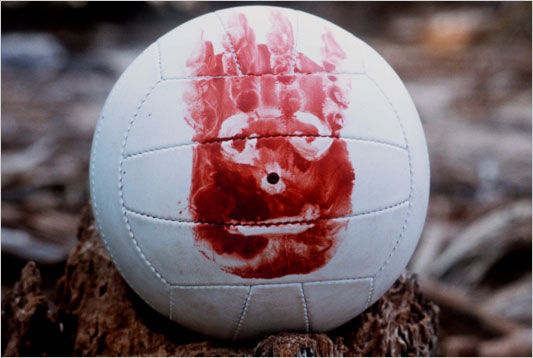
One of the greatest movie characters ever created… who is literally a volleyball. Tom Hanks is so good he creates a fully fleshed-out relationship with a rubber ball covered in handprint blood.
Wilson is the ultimate survival imaginary friend, and the audience feels his presence, his personality, his emotional arc, even though he never speaks. When Wilson floats away and Hanks screams “I’m sorry, Wilson!” it’s devastating. A volleyball breakup scene that made grown adults cry. That’s power.
8) “Suzie the Doll” from MAY (2003)

This movie is fantastically twisted, and Suzie the Doll might be the creepiest imaginary friend on the list. Angela Bettis gives an absolutely incredible performance as May, a lonely woman whose only real companion is this cracked-glass doll in a display case.
Suzie doesn’t talk or move, but she exerts influence over May’s mental collapse. She’s judgmental, mocking, a silent pressure cooker of psychological torment. And the way the movie uses the doll’s broken face as a metaphor for May’s unraveling is fantastic.
This is an imaginary friend who quietly pushes you toward madness, and it's one of the most disturbing “companions” in horror.
9) “Harvey the Rabbit” from HARVEY (1950)

A 6-foot-tall invisible rabbit who may or may not exist, and who may or may not be magical. Harvey is one of the most charming imaginary friends ever created, he is a gentle giant who is both whimsical and a bit unsettling.
James Stewart plays Elwood P. Dowd, a man whose best friend is this invisible rabbit, and the whole movie walks this perfect line between comedy, melancholy, and gentle fantasy. Is Harvey real? Is Elwood crazy? Does it matter?
Harvey is that rare imaginary friend who spreads kindness, not chaos... and the movie is a classic because of it.
10) “Frank the Bunny” from DONNIE DARKO (2001)

One of the most iconic imaginary friends in modern cinema, Frank is a demonic-looking rabbit who tells Donnie when the world will end. He is equal parts terrifying, mysterious, philosophical, and strangely comforting. He’s a guide, a tormentor, a time-travel messenger, and a symbol of Donnie’s unraveling mental state.
The design is incredible, with that reflective metal mask, the twisted smile, the looming presence. Frank is the imaginary friend who leads you into a metaphysical nightmare instead of helping you get through algebra class. And he’s unforgettable. Easily one of the greatest “not-real companions” in movie history.
Thanks for reading, and please SUBSCRIBE to my weekly NEWSLETTER!

